
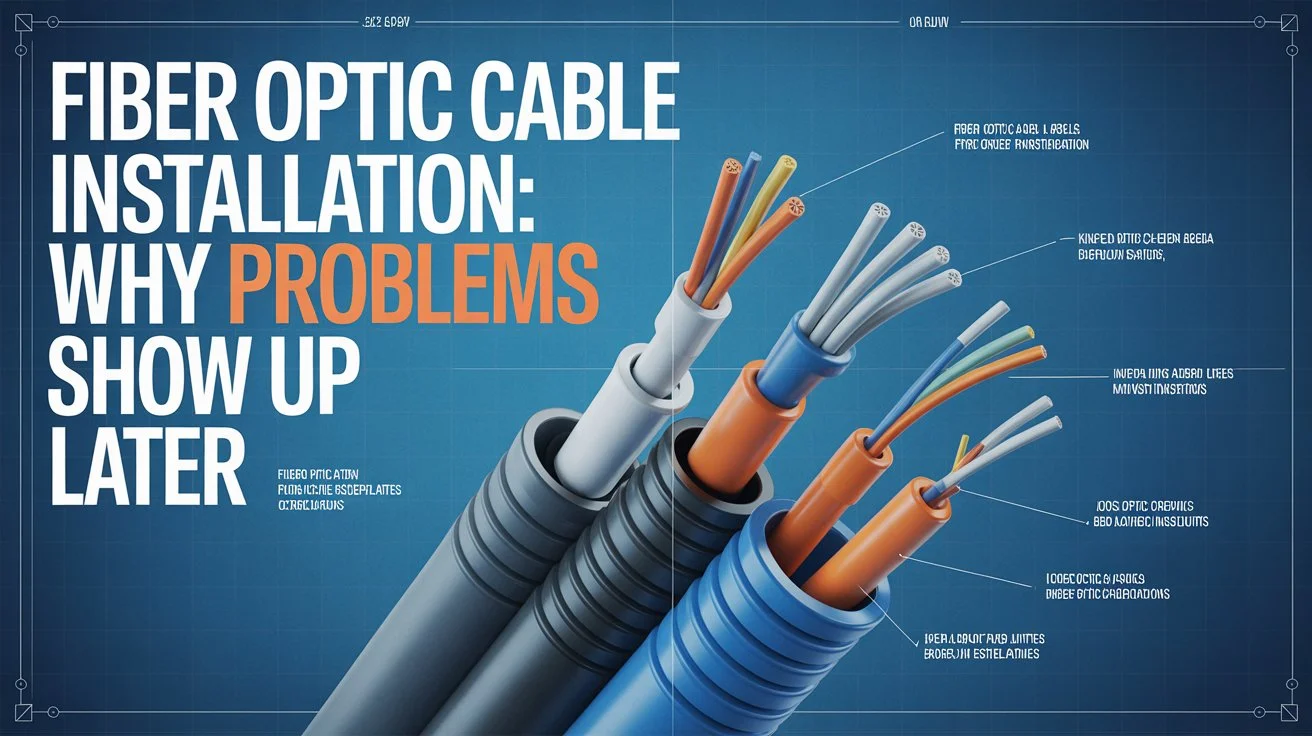
When my fiber optic cable installation was completed, I thought the story was over. The internet worked. It was fast. Everything loaded instantly. That felt like success.
For the first few weeks, I didn’t think about the cable at all. Which, in hindsight, was probably the point. Good internet is invisible when it works.
The problems didn’t arrive loudly. There was no sudden outage. No clear failure. Instead, things started to feel slightly off. A page would hesitate before loading. A video would buffer for a second and then continue. Once in a while, the connection dropped and came back on its own.
None of it felt serious enough to complain about. But it was enough to notice.
At first, I blamed everything except the installation. The router. The device. The weather. Even myself. It took a while to accept that the issue might have been there from the beginning.
Why Did Everything Work at First?
This was the question that bothered me the most.
If something was wrong, why didn’t it fail immediately?
That’s when I started reading about how fiber optic cables actually behave. Fiber carries light, not electricity. That makes it extremely fast, but also strangely forgiving in the beginning.
Small stresses introduced during installation do not always cause immediate failure. They weaken the connection slowly. Performance degrades in a way that feels random unless you understand what’s happening underneath.
I eventually came across explanations from industry bodies that pointed out that most fiber optic failures are caused by installation issues rather than manufacturing defects. That idea changed how I looked at the entire situation.
Nothing suddenly broke. The cable had been under stress from day one. It just took time for the effects to show.
Is Fiber Optic Cable Fragile or Strong?
Before this experience, I assumed fiber optic cable was either extremely delicate or nearly indestructible.
It turns out it’s neither.
Fiber is strong in normal conditions. It handles data incredibly well. But it doesn’t like being bent too tightly, pulled too hard, or pressed into awkward spaces. What makes fiber tricky is that it often tolerates these mistakes quietly.
That tolerance creates a false sense of security. The internet works, so everything must be fine. The damage is internal, invisible, and gradual.
That’s why people often ask why their fiber internet gets worse over time even though nothing looks damaged.
The Cable Type I Never Asked About
One thing that still surprises me is how little attention I paid to the actual cable being used.
I assumed fiber is fiber.
It isn’t.
Indoor fiber optic cables are designed for clean, stable environments. Outdoor fiber cables are built to handle heat, moisture, and temperature changes. When an indoor cable ends up exposed to conditions it wasn’t designed for, it doesn’t fail immediately.
It just ages faster.
This explains why some connections feel perfect at first and then slowly lose consistency. The cable is still working. It’s just no longer performing at its best.
Does Cable Routing Really Make That Much Difference?
At the time of installation, the routing looked neat. The cable followed clean lines. Nothing was visibly crushed or kinked. That felt reassuring.
Later, I learned that routing is one of the most underestimated parts of fiber optic installation.
Tight corners, sharp turns, and pressure points introduce constant stress. The cable jacket might look fine, but the fibers inside are under strain every single day.
This is why people experience signal loss without visible damage. The problem is internal, and it builds slowly.
Why Did the Installation Take So Long?
I remember thinking the installation felt slow. There was a lot of stopping, adjusting, and repositioning. At the time, it felt like overkill.
Now I understand why fiber optic cable installation is supposed to be slow.
Pulling the cable too hard or forcing it into place rarely causes immediate failure. Instead, it introduces internal stress that shows up later as instability. Speed during installation saves minutes. Care during installation saves months of frustration.
The careful pace is there for a reason.
Can Fiber Optic Cables Bend Too Much?
Yes, and this is one of the most common problems.
Fiber optic cables have specific bend limits. When those limits are exceeded, light escapes from the core. The cable still works, but not efficiently.
That inefficiency shows up as unstable speeds, packet loss, or random dropouts. The jacket looks fine. Nothing appears broken. But performance isn’t what it should be.
This explains why so many fiber issues feel inconsistent rather than completely broken.
How Can Something as Small as Dust Affect Fiber?
This was the part that surprised me the most.
Fiber connectors are extremely sensitive. A tiny dust particle that you cannot see can weaken the signal enough to matter. If connectors are not cleaned properly or are left exposed, performance suffers.
What makes this frustrating is that contamination doesn’t always cause immediate failure. The connection may test fine at first and then slowly degrade.
That gradual decline makes the problem harder to trace back to installation.
Isn’t Termination Just Plugging the Cable In?
I used to think termination was the simplest part of the process.
It isn’t.
Termination requires precise alignment. Small errors don’t kill the connection. They weaken it. That’s why some fiber connections feel unreliable instead of completely down.
These issues are especially difficult to diagnose later because everything appears connected and intact.
Why Testing Matters More Than I Realized
If there’s one step I now consider essential, it’s testing.
Fiber testing doesn’t just confirm that the internet works. It creates a performance baseline for future troubleshooting. Without that baseline, it’s impossible to know whether performance has changed or was always borderline.
Testing provides a reference point. It answers questions before they turn into guesses.
These practices are supported by international fiber optic standards published by IEEE because long-term reliability depends on documentation, not assumptions.
Skipping testing doesn’t save time. It delays understanding.
Why Do Fiber Problems Feel So Random?
One of the most frustrating parts of dealing with fiber issues is how inconsistent they feel.
The internet works most of the time. Then it doesn’t. Restarting the router helps sometimes, but not always. Everything looks fine physically.
This randomness is usually a sign of installation-related stress. The cable is operating close to its limits. Small changes in temperature, usage, or signal demand push it over the edge.
That’s why problems feel unpredictable.
The Early Signs I Ignored
Looking back, the warning signs were subtle but clear:
- Speeds were fast, but not consistent
- Drops were rare, but unexplained
- Physical inspection showed nothing wrong
- Equipment resets didn’t fix the issue
These are classic signs of installation-related fiber problems, not service outages or faulty hardware.
The inconsistency reminded me of earlier comparisons I had read about fiber optic vs cable internet speed, especially how expectations don’t always match real usage.
How Fiber Optic Issues Are Usually Diagnosed
Good troubleshooting doesn’t start with replacing equipment.
It starts with inspection. Connectors are checked for cleanliness. Routing paths are reviewed. Test results are compared. In many cases, the issue leads back to something small that happened during installation.
That’s when it becomes clear that the problem was never new.
What Living With This Taught Me
The biggest lesson I learned is that fiber optic cable installation isn’t about making the internet work today. It’s about making sure it keeps working over time.
The best fiber connections are the ones nobody talks about because nothing ever goes wrong. That level of reliability comes from careful choices made during installation, even when those choices don’t seem important at the moment.
If I could go back, I wouldn’t rush the process or ignore the details. With fiber, the details are what last.
A Few Questions I Had (And You Might Too)
Why does fiber optic internet slow down after installation?
In most cases, it’s not the service speed changing. It’s small installation-related issues adding up over time. Tight bends, internal stress, or connector contamination can slowly reduce signal quality, even though everything looks fine from the outside.
Can fiber optic cables go bad on their own?
Rarely. Fiber optic cables are manufactured to last a long time. When problems show up, they’re usually linked to how the cable was handled, routed, or terminated during installation rather than the cable itself failing.
Is fiber optic cable more fragile than copper?
Not exactly. Fiber is strong in normal conditions, but it’s less forgiving when it comes to bending, pulling, and pressure. Copper tends to fail loudly. Fiber fails quietly, which makes issues harder to notice early.
Why do fiber problems feel random and inconsistent?
Because the cable is often operating close to its limits. Small changes like temperature shifts, higher usage, or minor signal variations can push it over the edge. That’s why everything can feel fine one moment and unstable the next.
Should fiber testing really matter if the internet already works?
Yes. Testing isn’t about confirming that the internet works today. It’s about knowing how well it worked on day one. Without that reference, it’s difficult to tell whether performance has changed or was always borderline.
Can installation issues show up months later?
Absolutely. That’s one of the most confusing parts of fiber. Stress introduced during installation doesn’t always cause immediate problems. It often shows up later, once the cable has been in use for a while.
What’s the biggest mistake people make with fiber installation?
Assuming that “working” means “done.” Fiber can work and still be stressed. The most reliable installations are the ones where extra care was taken even when it seemed unnecessary at the time.

