
If you’ve ever lost a match because of lag (delay between your actions), then you already know how frustrating a poor internet connection can be.
Imagine this: you’re playing a cricket game. You need 3 sixes in the last over to win. Pressure is high. You time the first shot perfectly… and suddenly, the screen freezes. For a second, everything just hangs: the batsman, the ball, even the crowd. Then the game catches up… and you’re already out.
That loss? Not your mistake. Just bad internet.
The same thing happens in other games too. You press a button, but your character reacts late. You make the right move, but the game doesn’t register it. Or worse—you get disconnected in the middle of a ranked match.
For many gamers, these moments aren’t about skill; they’re about internet performance.
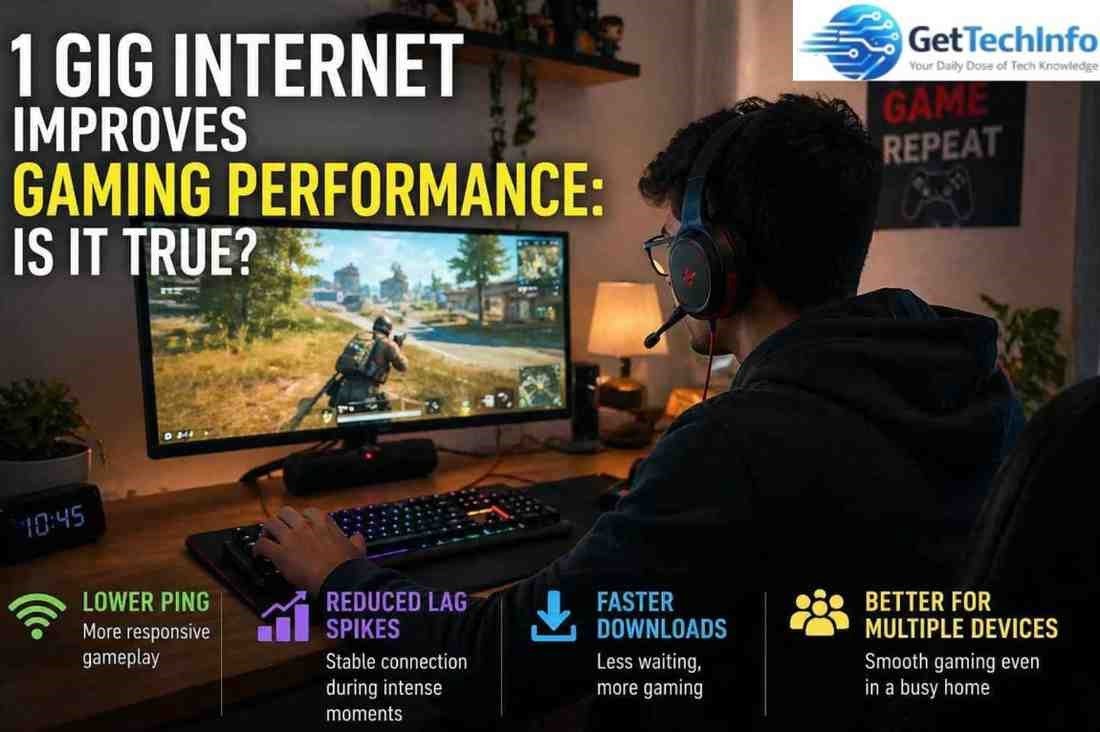
That’s exactly why more players are upgrading to 1 Gig Internet (gigabit internet). But how does it actually improve gaming performance? Is it just about faster speeds, or is there more going on behind the scenes?
Let’s break it down in a simple, real-world way.
Is Gaming Just About Speed, or Does Stability Matter More?
One of the biggest misunderstandings in gaming is that higher internet speed automatically means better performance.
But in reality, stability matters more than raw speed.
Most online games don’t use a lot of bandwidth. Even competitive multiplayer titles like Call of Duty: Warzone, Valorant, Fortnite, and PUBG: Battlegrounds often require less than 10 Mbps.
Similarly, according to Netflix, around 15–25 Mbps is enough for 4K streaming, which shows that even high-quality online activities don’t need extremely high speeds.
So why do gamers still care about gigabit internet?
Because a 1 Gig connection provides consistency, especially when your network is under load.
- Fewer sudden slowdowns
- A more stable connection during matches
- Less interference from other devices
This becomes especially important in competitive gaming, where even a small delay can decide the outcome.
8 Major Benefits of 1 Gig Internet for Gaming Performance
Lower Ping and More Consistent Latency
When people ask, “Does faster internet reduce lag?”, what they usually mean is:
Will it reduce ping?
Ping (latency) is the time it takes for your device to communicate with the game server. Lower ping means faster response, which directly affects how quickly your actions register in-game.
For example, you press the shoot button—if your ping is low, the action happens instantly. But if your ping is high, there’s a slight delay, and your opponent may react first.
Now here’s where 1 gig internet comes in. It doesn’t magically give you ultra-low ping, but it helps maintain more consistent latency, which is just as important during gameplay.
Because in real matches, the problem isn’t always high ping—it’s sudden spikes. One moment everything feels smooth, and the next moment your game stutters or delays.
That’s why consistency matters.
- No sudden ping spikes, so your game doesn’t freeze mid-fight
- Smooth character movement, without teleporting or rubberbanding
- Faster reaction time, as your inputs register on time
- Better hit registration, so your shots land when they should
Imagine you’re in a close fight. You aim perfectly and fire—but a sudden spike delays your action, and you lose the fight even though your timing was right.
That’s the difference between unstable and consistent latency.In most gaming setups, smooth performance depends on low latency and stable connections, as explained by network providers like Cloudflare.
In fast-paced games like shooters or battle royale titles, even a few milliseconds can impact performance—especially in competitive matches.
What Is Considered Good Gaming Network Performance?
To understand performance better, here are some practical benchmarks:
Ping:
- Under 20 ms → Excellent
- 20–50 ms → Good
- 50–100 ms → Playable but noticeable delay
Packet Loss:
- 0% → Ideal
- 1–2% → Minor issues
- Above 2% → Can cause lag and disconnections
Jitter (connection stability):
- Under 30 ms → Stable
- Higher → Can cause inconsistent gameplay
Reduced Lag Spikes During Gameplay
Lag spikes are one of the most common issues gamers face.
You might have experienced this:
- At first, your game runs smoothly… then suddenly freezes
- Ping jumps from 20 ms to 150 ms
- Your character teleports or stutters
This usually happens when your connection can’t handle sudden traffic—like background downloads, other devices using the internet, or unstable Wi-Fi.
With 1 gig internet, your network has more capacity to handle these situations. Even when multiple things are happening at once, the connection stays more stable and data flows smoothly.
The result: fewer sudden spikes and a more consistent gameplay experience.
Because in real matches, it’s not constant lag that hurts the most—it’s those unexpected spikes that throw you off at the worst moment.
Faster Game Downloads and Updates
Modern gaming isn’t just about playing; it’s also about downloading, installing, and constantly updating games.
And let’s be honest—games today are huge.
- 50 GB is now normal
- 100 GB+ is very common
- Updates can easily be 20–30 GB
Now think about your actual routine. You come home after a long day, open your system, and see a 25 GB update waiting.
On a slower connection (like 50–100 Mbps):
- You’re waiting 1–3 hours
- Sometimes even longer during peak time
- By the time it finishes, your mood to play is gone
With 1 Gig Internet:
- The same update can finish much faster (often within minutes, depending on servers)
- Installs don’t feel like a chore anymore
- You spend more time playing, not waiting
Real-life scenario
Your friend texts: “Hey, a new game just dropped—join quickly!”
You open your system and start the download.
On a slower connection, the progress bar barely moves. You end up replying, “It’s still downloading… you guys go ahead; I’ll try to join later.”
But with gigabit internet, things feel completely different. The download finishes much faster, and instead of missing out, you can say, “Give me 20 minutes max—don’t start without me, I’m coming.”
That’s the real difference.
It’s not just about speed—it’s about not missing out.
And for most gamers, that alone makes gigabit internet feel worth it.
Better Performance with Multiple Devices
This is where 1 gig internet truly shines.
In most homes, you are not the only one using the internet:
- Someone is streaming Netflix
- Someone is on a video call
- Someone is browsing or downloading
- Smart devices are always connected
On slower plans, all of this competes with your game.
With 1 Gig Internet:
- Your gaming traffic gets enough bandwidth
- Other activities don’t affect your performance
- No need to ask others to “stop using Wi-Fi”
This is why many people search for “best internet speed for gaming in a shared home”.
Smooth Streaming While Gaming
Gaming today isn’t just about playing—it’s about doing multiple things at the same time.
Most gamers don’t just sit and play quietly. You’re usually:
- Streaming on YouTube or Twitch
- Talking to friends on Discord
- Uploading clips or highlights
- Watching a guide on your second screen
Now imagine this situation:
You’re in the middle of an intense match, talking to your team, and streaming at the same time. Suddenly, your stream starts buffering, your voice breaks on Discord, and your game begins to lag.
That’s not your PC—it’s your internet struggling to handle everything together.
On a slower connection:
- Stream quality drops or buffers
- Voice chat becomes choppy (“Hello… hello… you there?”)
- Game performance starts to feel unstable
With 1 Gig Internet:
- You can stream smoothly in HD or even 4K
- Upload speeds stay stable
- No random buffering or frame drops
- Voice chat remains clear during crucial moments
Real-life scenario
You’re playing with your squad and streaming at the same time.
- Slow internet → “Guys, my stream is lagging… and Discord is glitching too. Give me a second.”
- Gigabit internet → “Stream’s live, voice is clear—let’s push now.”
That’s the difference.
It’s not just about playing—it’s about doing everything together without your connection falling apart.
For streamers and even regular gamers who multitask, this makes a huge difference in overall experience.
Reduced Packet Loss and Disconnections
Another key factor in gaming performance is packet loss.
Packet loss happens when data doesn’t reach its destination properly. This leads to:
- Missed shots
- Delayed movement
- Rubberbanding
- Random disconnects
A higher-capacity connection like gigabit internet reduces the chances of packet loss, especially during heavy usage.
This results in:
- More reliable matches
- Fewer unexpected issues
- Better overall gameplay experience
Better Support for Competitive Gaming
If you play ranked or competitive games, consistency is everything.
In competitive gaming:
- Reaction time matters
- Stability matters
- Every millisecond counts
A 1 Gig connection helps by:
- Reducing interruptions
- Maintaining stable ping
- Supporting real-time responsiveness
While it won’t improve your skill, it removes technical disadvantages.
Improved Network Efficiency at Home
Gigabit internet doesn’t just improve gaming—it improves your entire network.
With more bandwidth available:
- Devices don’t compete as much
- Network congestion is reduced
- Performance remains consistent
This is especially useful in:
- Families
- Shared apartments
- Gaming households
- Smart homes
Future-Proof Gaming Performance
Gaming is evolving fast.
We are seeing:
- Cloud gaming services
- Larger game sizes
- Always-online gameplay
- More connected devices
A 1 Gig Internet connection prepares you for the future.
Instead of upgrading again later, you are already ready for:
- Higher demands
- New technologies
- Better overall performance
When 1 Gig Internet Makes the Most Difference?
You will notice the biggest improvement if:
- You experience frequent lag spikes
- Your home has multiple users
- You download large games regularly
- You stream or multitask
- Your current connection feels inconsistent
In these situations, gigabit internet can significantly improve your gaming experience.
However, if you’re confused between different speed options, you can also check this detailed comparison on 500 Mbps vs 1 Gig for gaming to understand which plan fits your needs better.
| Internet Speed | Gaming Experience |
| 100 Mbps | Good for solo gaming |
| 300–500 Mbps | Smooth for most users |
| 1 Gig Internet | Best for multitasking, streaming, and busy homes |
When It Might Not Be Necessary?
To be honest, not everyone needs 1 gig Internet.
If you:
- Live alone
- Play casually
- Have minimal internet usage
Then a lower-speed plan may be enough.
However, even then, gigabit internet still offers the following:
- Faster downloads
- Better stability
- More convenience
Final Thoughts
So, how does 1 gig Internet actually improve gaming performance? It’s not just about higher speed,the real difference comes from how stable and consistent your connection feels during gameplay. With a stronger network, you get fewer lag spikes, smoother gameplay, faster downloads, and better performance even when multiple devices are connected at the same time. In simple terms, it removes the small technical issues that quietly ruin your experience, and once those issues are gone, everything just feels smoother, more responsive, and far less frustrating.
Frequently Asked Questions
1. Does faster internet reduce lag in gaming?
Not always. Lag mainly depends on ping (latency) and connection stability, not just speed. A faster connection can help, but if your latency is high or unstable, you may still experience lag.
2. Is 1 Gig Internet overkill for gaming?
For solo gaming, it can be more than enough. However, in busy households or for multitasking (streaming, downloads, multiple devices), 1 Gig Internet provides better stability and overall performance.
3. What is a good ping for online gaming?
A ping under 50 ms is considered good for most games, while under 20 ms is ideal for competitive gaming. Higher ping can cause delays and affect gameplay responsiveness.
4. 1 Gig vs 500 Mbps for gaming—which is better?
For pure gaming, both perform similarly. But 1 Gig Internet handles multiple devices and background activity better, making it a better choice for shared homes or heavy usage.
5. Why do I still lag even with fast internet?
Lag can happen due to high ping, unstable Wi-Fi, packet loss, or network congestion, even if your speed is high. Gaming performance depends more on stability than just download speed.

