
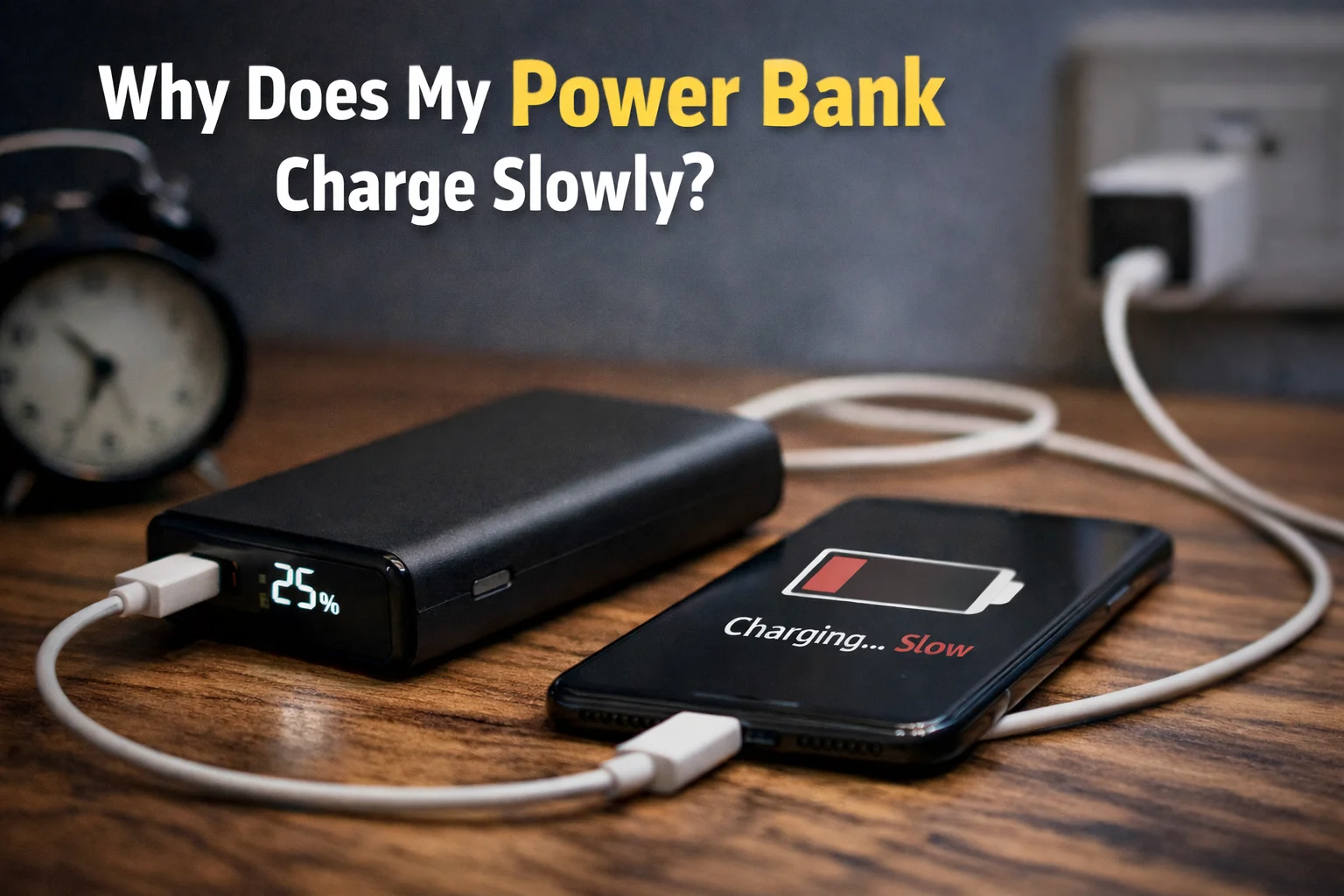
A few weeks ago, I noticed something odd. My power bank was charging, but painfully slowly. I plugged it in before sleeping, expecting it to be full by morning. Instead, it barely crossed halfway. At first, I ignored it, thinking it was a one-time issue. But when it happened again, I knew something wasn’t right.
If your power bank charging slowly and taking longer than it used to, you’re not alone. I’ve dealt with this issue more than once, and in most cases, the problem wasn’t the power bank itself. It was something small and easy to miss.
Let’s go through the real reasons this happens and what actually works.
A few weeks ago, I noticed something odd. My power bank was charging, but painfully slowly. I plugged it in before sleeping, expecting it to be full by morning. Instead, it barely crossed halfway. At first, I ignored it, thinking it was a one-time issue. But when it happened again, I knew something wasn’t right.
If your power bank charging slowly and taking longer than it used to, you’re not alone. I’ve dealt with this issue more than once, and in many cases, the problem was not the power bank itself. It was usually something small and easy to miss, such as a weak charger, damaged cable, overheating, or battery wear.
Many users assume the power bank is faulty, but slow charging is often caused by the charging setup rather than the device itself.
Let’s go through the real reasons this happens and what actually works.
Yes, slow charging can be normal — up to a point.
Power banks are designed to protect their batteries, so they do not always charge at maximum speed. Charging time depends on battery capacity, charger output, cable quality, and temperature.
For example, a 20,000 mAh power bank with a basic charger will naturally take longer to charge than a 10,000 mAh model with a faster adapter.
However, if your power bank:
- Takes much longer than before
- Gets stuck at certain percentages
- Charges faster sometimes and slower at other times
then there is usually a specific reason behind it.
Many users find that slow charging is often caused by a weak cable, low-power charger, charging port issue, or battery aging rather than the power bank itself.
A Poor or Damaged Charging Cable Can Cause Slow Power Bank Charging
This was one of the biggest surprises for me.
I was using an old cable that still worked fine with my phone. But after switching to a newer, better-quality cable, my power bank charging time was reduced by around 2 to 3 hours.
Many users assume that if a cable works, it is working properly. In reality, damaged or low-quality cables can still charge, but often at a much slower speed.
This usually happens because worn internal wires, loose connectors, or higher resistance reduce the amount of power reaching the power bank.
Quick Check: Try a short, good-quality cable first. In many cases, this simple change noticeably improves slow charging.
Low-Power Chargers or Adapters Can Make a Power Bank Charge Slowly
Another mistake I made was charging my power bank using a laptop USB port. It charged, but very slowly.
Power banks need enough input power to charge properly. Common slow sources include:
- Laptop or PC USB ports
- Old wall adapters
- Low-output car chargers
If your adapter outputs only 5V/1A, charging will be slow — especially for high-capacity power banks.
Tip from real use:
Use the same adapter you’d trust for a tablet or fast-charging phone.
Power Bank Capacity Can Affect Charging Time
A higher-capacity power bank naturally takes longer to charge.
For example:
- 10,000 mAh → reasonable charging time
- 20,000 mAh or more → much longer charging time
Problems start when a large power bank is paired with a weak adapter. In that case, slow charging is expected and unavoidable.
This doesn’t mean the power bank is faulty — it just means expectations need to match the hardware.
Battery Aging: The Slow Change You Don’t Notice
After months or years of use, power banks don’t behave the same way they did when new.
Over time, power banks slow down because of lithium-ion battery aging and degradation, which naturally reduces charging efficiency and capacity.
You may notice:
- More heat while charging
- Slower progress after 50–60%
- Faster battery drain during use
Sadly, this part can’t be fixed. Aging batteries slow down no matter what you do.
Charging Devices While Charging the Power Bank Slows Charging
Yes, this really affects charging speed.
When you charge your phone from a power bank that’s also plugged in, the incoming power gets divided. Part goes to your phone, and only the remaining power charges the power bank.
This makes the power bank charge extremely slowly.
Best practice:
Let the power bank charge on its own. Use it only after it’s fully charged.
Overheating Can Automatically Slow Power Bank Charging
If your power bank feels warm, it will slow itself down to prevent damage.
Common heat causes:
- Charging in direct sunlight
- Poor airflow
- Using the power bank while charging
- Cheap internal components
Always charge power banks:
- On a flat surface
- In a cool, ventilated area
- Without covering them
Heat management makes a noticeable difference.
Is Fast Charging Safe for a Power Bank?
This is something many people worry about.
If your power bank supports fast-charging input, using a fast charger is safe. If it doesn’t, the power bank simply limits the speed on its own.
Using a fast charger won’t force or damage a basic power bank. It will only take what it can safely handle.
When Slow Charging Means It’s Time to Replace Your Power Bank?
Sometimes, slow charging is a warning sign.
You should consider replacing your power bank if:
- Charging time keeps increasing
- It heats up often
- It drains very quickly
- It’s over 2–3 years old with heavy use
At that stage, battery wear is the real issue.
Power Bank Charging Slowly? What to Check First
If your power bank is charging slowly, check these in order:
- Change the charging cable
- Try a stronger wall adapter
- Avoid charging devices at the same time
- Charge in a cool, open space
- Consider age and capacity limits
Most people solve the issue in the first two steps.
Final Thoughts on Fixing a Slow Charging Power Bank
In my case, the slow charging problem turned out to be a combination of a weak adapter and a worn cable. Once I fixed those, charging times improved immediately.
Power banks are simple devices, but they depend heavily on the accessories you use with them. Before assuming your power bank is defective, fix the small things first. It can save you hours of waiting and unnecessary replacements.
FAQ:-

